Lovely Jamison-Duckworth is an early childhood educator who owns and operates Lovely’s Little Angels, a family child care program in Bridgeport, Connecticut. Last year, she and the children in her program took part in an initiative to help lawmakers understand the importance of family child care and encourage them to back nationwide efforts to increase funding and support for all types of early care and education.
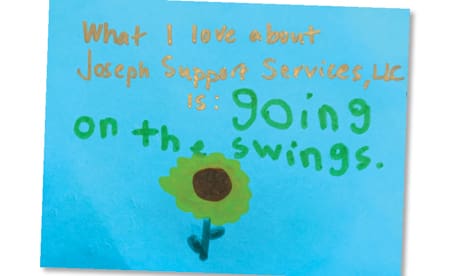
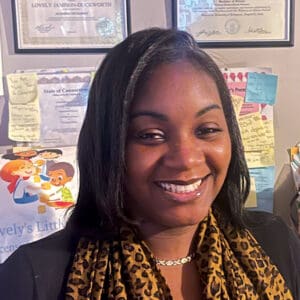 Over several weeks, everyone at Lovely’s Little Angels wrote, colored, addressed, and stamped a series of brightly-colored postcards with messages about the importance of early care, and why they love their family child care program. They then mailed them to Connecticut’s representatives in Washington, D.C.
For Ms. Lovely, the project was a way to develop a personal connection with advocacy. It was “an individual and community effort to make family child care educators and programs stand out. The postcards gave a personal touch through the children’s own designs. Also, it allowed us as educators to further express our jobs as professionals. I think it grabbed the attention of senators and [members of] Congress.”
Ms. Lovely worked on the project with her educational coach, Lisa Fay, from All Our Kin, a national nonprofit organization that trains, supports, and sustains family child care educators.
“The postcards were about equity and centering the voice of educators by giving them another way to engage,” said Fay. The timing of her project aligned with a ramping-up of advocacy efforts across the country, as the federal government began to talk seriously about major investments in the child care system.
Last year was hugely important for early care and education advocacy. While the COVID-19 pandemic wreaked a second year of havoc, it also highlighted the essential role that child care plays in our economy. Family child care proponents and educators alike celebrated as we were able to grab the attention of state and federal lawmakers, in order to secure emergency relief for family child care businesses and help to shape long-term solutions through the Build Back Better Act, which the House of Representatives approved last fall. Months later, when the Senate failed to include child care in a funding package based on Build Back Better, Connecticut’s Senior Senator, Richard Blumenthal, spoke about his disappointment on the floor of the senate.
He said new funding is “important to the men and women who form the child care workforce … They do great work. They have been doing great work during the pandemic, reporting for duty, taking care of children, even as their industry was impacted by smaller amounts of children being able to go there because parents had smaller amounts of income to afford it … So I am absolutely determined that we will move forward on child care.” (Congressional Record, 2022)
By this time, however, Ms. Lovely and other child care educators had already pivoted to emphasize the need for more child care funding from the state of Connecticut. She and other family child care educators hosted A Morning Without Child Care at a public park in Bridgeport. Child care programs opened two hours late that day, encouraging parents and children to attend a rally in support of better funding. They were joined by educators, families, and community leaders in cities and towns across the state. Their actions received extensive coverage in the news media (CT Public Radio, 2022; Lank, Hernandez, 2022; Fry, 2022). Two months later, the Connecticut General Assembly increased child care funding by 30 percent, an unprecedented increase in a single year. And Ms. Lovely and her colleagues inspired child care providers across the country to have a nationwide Day Without Child Care.
Family child care educators nurture more than three million children across the United States, yet remain relatively invisible in the eyes of legislators and policymakers. All Our Kin partners with educators as they share their stories and communicate with elected officials and other decision makers about ways to support the field and transform early care and education systems to better serve children, families, and providers. After all, nobody knows more about solutions to the challenges family child care educators face than educators themselves.
Elevating the voices of family child care educators has the potential to improve the structural environment in which they work. Educators’ stories are a powerful catalyst for personal, professional, and social change. When others identify with the narrator’s experience, storytelling can lead to new pedagogical or business practices, or as recognition of the need for new public policies.
The reverse is also true: change that is foisted upon educators without connecting to their personal stories and experiences is unlikely to succeed. We saw this recently with the first of three federal pandemic relief packages. The CARES Act, which made Payroll Protection Program funds available at the beginning of the pandemic, was nearly impossible for family child care providers to access.
The program had a cumbersome application process that was not set up for home-based businesses. Educators could only apply if they had social security numbers and commercial bank accounts. Banks had little incentive to work with small businesses and were unresponsive to requests from educators. After listening to family child care providers and other home-based businesses in legislative meetings, Congress modified the program substantially. The application was simplified; businesses could apply through community-based lenders and FINTECHs—digital financial services companies such as PayPal—which many already used. Funds were reserved for minority and women-owned businesses. Family child care educators were able to tap this source of funding, which became a lifeline for many.
ADVERTISEMENT

Meeting with elected officials is a powerful way to influence policy decisions at the local, state, and federal levels. Lawmakers hear about a number of issues from their constituents and the loudest voices often get the most attention. This is why it is critical for elected officials to hear often and directly from family child care educators about the issues impacting them. A silver lining of the pandemic? The shift to a world of online engagement has made meeting with lawmakers more feasible for family child care educators who cannot leave their homes during the workday.
Many family child care educators are already seasoned community leaders and advocates, which is why we invite them to speak about family child care for news interviews, legislative hearings, panel discussions, professional events, and more. In sharing their experiences, they help to highlight child care as an integral part of our nation’s communities and economic framework.
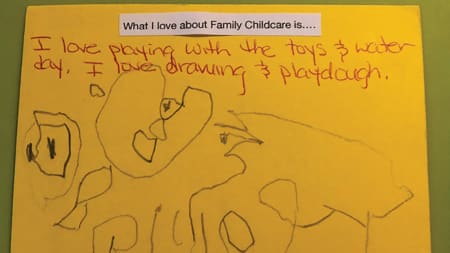
The children wrote and drew on brightly-colored postcards with messages about the importance of early care and mailed them to Washington D.C.
 The educators in our network have given testimony on a range of issues, including discriminatory housing practices and the need for increased federal investment in early care and education. In 2021, All Our Kin educators Bernadette Ngoh and Rebecca Gonzalez testified in front of the Senate Banking Committee and the House Ways and Means Committee, respectively. Their testimony and that of other educators helps lawmakers understand how legislation will directly impact educators and the families they serve.
Ms. Lovely wrote a postcard to Representative Rosa DeLauro, thanking her for introducing the Child Care is Essential Act. Her message read, “This will enable providers to offer safe, healthy care and make up for lost income due to the pandemic.” While COVID-19 has posed many hardships for early childhood educators, it is also starting to give them the widespread recognition and respect they deserve.
Ms. Lovely has worked in the early education field for over 18 years, and has been running her licensed family child care program since she purchased her own home in 2017, although it has been her dream since she was a teenager.
“Today, that dream is manifested, and I humbly accept the ups and downs as a business owner in a field I love dearly. I love family child care because it is a small group of children, which allows for more individualized care and attention. I get to see the children in their own element. They get to play, laugh, learn, and have fun. It is amazing.”
The advocacy work she has undertaken is important, especially because family child care has been overlooked in decision making arenas. She says, “More people should know about family child care. It is a professional setting. It is important for [lawmakers] to acknowledge us all and give us the same benefits. Why not make us equal?”
We have seen educators like Ms. Lovely excel as advocates. We hope that by partnering in this work, they can begin to counter narratives, even internal ones, that tell them otherwise.
References
Congressional Record. (August 6, 2022). Proceedings and Debates of the 117th Congress, Second Session. Congressional Record, 168(133), 11. congress.gov
Connecticut Public Radio. (2022, March 14). Child care providers on brink of “collapse,” calling for $700 million in state funding. ctpublic.org
Lank, O and Hernandez, S. (2022, March 15). Rallies happening across CT to bring attention to crisis in childcare. News 8. wtnh.com
Fry, E. (2022, March 15). Bridgeport parents, child care providers rally for state funding. CT Post. ctpost.com

Dana Holahan is the director of professional development at All Our Kin, Inc. and enjoys all aspects of organizing high-quality learning experiences for its networks of family child care educators. She is especially passionate about racial equity, access to resources for Spanish speakers, early literacy, and outdoor education. She lives in New Haven, Connecticut.

Jade Thomas is the Connecticut early care and education policy fellow at All Our Kin. In this role, she helps to lead the organization's state-based policy and advocacy efforts. She is most thrilled by the opportunity to uplift the voices of educators through her work.

Christie Balka is All Our Kin's vice president of policy. In this role, she supports a variety of local, state and federal policy initiatives designed to create the conditions for family child care to thrive.
Share this Story
Print Friendly Version

ADVERTISEMENT

Related



ADVERTISEMENT