“Hello Mister Kate,” a girl says with a laugh and a grin, beginning a chorus of “Hello Mister Kate,” as all 14 students in my class laugh at their joke. I smile and laugh too, saying hello back because they do not realize this is more gender-affirming than being called ‘Miss Kate.’ This coupled with comments I have heard from my students that, “You can’t be a girl because you have a penis,” has given me the perfect idea for our daily classroom meeting topic. I want to make the world a safer place for gender nonconforming kids and as a gender nonconforming teacher I have that ability (Feeney et al., 2019). Soon we are all seated around the circle carpet and I begin the meeting with a responsive activity.
“Raise your hand if you are a girl. And raise your hand if you are a boy. Now raise your hand if you’re not a boy and not a girl, but instead are both and neither at the same time.” I raise my hand and the 3- and 4-year-old preschool students stare back at me in confusion. “Are you a girl or a boy?” one student asks, and I say, “I am not a boy or a girl, I am something called non-binary. Some days I feel like a boy, some days I feel like a girl, and other days I do not feel like either.”
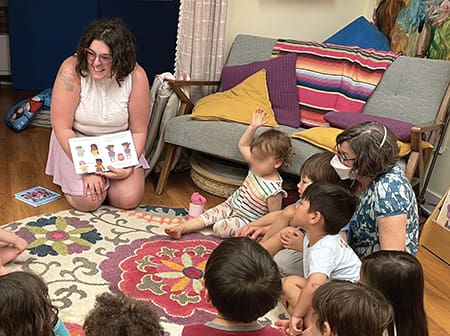
Gender is more than a binary or even a spectrum, I feel it is a galaxy of individual stars of identity and I am the astronomer guiding my students through the cosmos that has existed for millennia. [©Kate Selden]
“If you are not a girl, then what are you?” A boy asks, and I do not take offense. I recognize that the child’s thought process is a reflection of the gender binary as society imposes it on children. I say, “I am just a person,” as another student exclaims “You are a they!” And with pride, I began to read “Being You: A First Conversation About Gender” (Madison et al., 2023) and explain what pronouns are. “Why are you saying ‘they’ when there is only one person?” the girl who called me Mister asks. “Good job noticing ‘they’ usually means more than one person, but ‘they’ is also a singular pronoun, it is the pronoun I use. You can say Teacher Kate is eating their lunch in their classroom.”
As we continue to read, more questions arise. “What is trans?” My co-teacher, a cisgender woman, explains, “trans is short for transitioning, where someone who was told they were a boy or a girl transitions to the gender they identify as and live as a girl or a boy who is transgender.”
At the end of our conversation, one of my 4-year-old students says, “You know, some days I do not feel like a girl, but I do not feel like a boy either” and I replied, “That is okay. No matter what gender you feel like, you are you, and you are loved. I love you.”
“Do you love me?” the girl who called me Mister asks. “I love all of my students.” “Even when you are mad at us?” I laugh and explain, “Even when I get frustrated with your choices, I still love you. And I come to school every day ready to love you again.”
“Again, and again, and again, and again, forever and ever?” the gender-questioning student asks with a radiant smile, and I say, “Yes.” I specifically refer to this student as gender-questioning because it would be a rigid categorization to label this student as non-binary after one statement. What is important is to support students’ gender exploration from day-to-day as they navigate gender through pretend/dramatic play which heightens social-emotional development, engages creativity, and develops cognitive strategies (Feeney et al., 2019). Gender is more than a binary or even a spectrum, I feel it is a galaxy of individual stars of identity and I am the astronomer guiding my students through the cosmos that has existed for millennia.
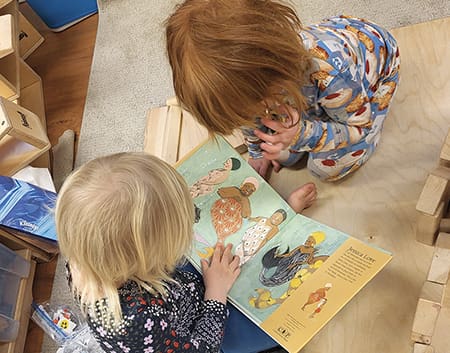
Next, I introduced “The Meaning of Pride” (Thor & Kirk, 2022) and while this text was too advanced for my young students to follow along with, they loved the pictures. “I love his big red dress!” a boy exclaims, pointing to a drawing of Billy Porter in the tuxedo dress designed by Christian Siriano for the 2023 Golden Globe Awards. “I like her green clothes,” another boy says, pointing to RuPaul Andre Charles. “That is actually a boy dressed up like a girl, he is called a drag queen.” I explain, “Well I like his green clothes too,” my gender-questioning student says. With this fascination with the imagery of drag, I decided to read “Julián is a Mermaid” (Love & Roque, 2020). “They are so beautiful,” one girl says, and I catch her later admiring the images of older plus-size drag queens of color with a friend during open play time.
ADVERTISEMENT

Later in the week one of my gender exploring students who happens to have a penis is making pretend food out of kinetic sand and says “No boys allowed!” I know I need to say something before more students start excluding others based on gender. “We don’t exclude people because of who they are,” and the student says “Okay. This food is for girls and this food is for boys.” I challenge them with curiosity by asking, “What if you’re not a boy or a girl? What food do they get?” And they pause, thinking for a moment, before saying, “They get pasta.” I can’t help but laugh as I repeat back to them, “If you’re not a boy or a girl you eat pasta?” “Yeah, mac and cheese.”
My classroom culture around gender stereotypes has changed dramatically since this conversation. A new teacher was visiting my classroom and referred to a group of students with penises as boys and one boy said, “Actually, he’s a girl” referring to a gender exploring student who frequently corrects people that he is a girl, but still uses he/him pronouns by choice. While learning about babies and birth, one of my cisgender co-teachers referred to mommies having babies in their wombs and a student said, “Daddies can have babies in their wombs too,” and I was brought to tears because my 3-year-old student was learning to love instead of hate.
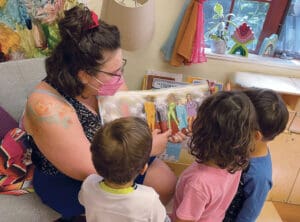
Denying a child the right to express their gender identity damages not only the relationship between the child and that adult, but it damages the child’s own sense of self. [©Kate Selden]
One of my students has a transgender sister who is in elementary school. I had no idea she was transgender until I asked my teaching team if her masculine sounding name was a nickname, and a co-teacher who knew the student before she transitioned explained her gender identity to me. Reflecting on transgender joy I realized what helped children like her and me was acceptance by our families and the use of our pronouns. I may not have come out until I was 20, but cisgender people ask a lot of the time when you knew you were not a girl, and I knew when I was a toddler and I asked my mom if I was a boy and she quickly said “No.” But I was a boy, and a girl, and both and neither. You do not have to understand, but you have to be respectful and acknowledge that an individual knows their gender better than anyone else.
Denying a child the right to express their gender identity damages not only the relationship between the child and that adult, but it damages the child’s own sense of self (Feeney et al., 2019). That is why many argue that using a person’s correct pronouns is suicide prevention, and I believe this is especially true with transgender youth. While the future can feel unknown and the unknown is scary,
I take heart in knowing that by embracing gender creativity in the classroom I am saving children’s lives.
[©Kate Selden]
Gender curiosity is not new, but what is new is the media attention of transgender youth. Some adults would find these conversations threatening to their cultural or religious identity. Children actually begin developing a sense of their gender identity around 3 years old, so conversations about gender will inevitably arise (Feeney et al., 2019). How can we celebrate racial diversity without including LGBTQ+ people of color who created Pride itself? I argue that not having these conversations is threatening to my very life and existence as a non-binary transgender teacher. How can I teach my students to be their authentic selves if I am not allowed to be my authentic self in the classroom?
References
Feeney, S., Freeman, N.K., & Schaffer, K. (2019). Gender Expression and Identity. Young Children, 74(5), 84–93. jstor.org
Love, J. & Roque, A. (2020). Julián is a mermaid. Dreamscape Media, LLC.
Madison, M., Lee, L.M., Passchier, A., & Passchier, A. (2023). Being you: A first conversation about gender. Playaway Products, LLC.
Thor, R. & Kirk, S. (2022). The meaning of pride. Harper Collins Children’s Books.

Kate Selden is a non-binary queer preschool teacher in Seattle, Washington, since January 2023. Originally from Enumclaw, Washington, they earned their bachelor of fine arts in tech theatre design and with a minor in writing from Pacific Lutheran University in Tacoma in 2018, followed by their bachelor of arts in literature from Evergreen State College in Olympia in 2021.
Share this Story
Print Friendly Version

ADVERTISEMENT

Related


ADVERTISEMENT