We reverently acknowledge the ancestral, traditional and unceded aboriginal territories of the Coast Salish First Nations where we work, live, play and learn. We share our respects to the elders, we honour with gratitude the land itself and the people who have stewarded it and commit ourselves to the journey of reconciliation in Canada.
There comes a point in a long career where one either settles in and accepts the status quo or becomes unsettled and hungry to reimagine the ways things are. We are four early childhood professionals who found ourselves longing deeply for shared learning opportunities in our field that held something more than the status quo: more connection, collaboration, and a gateway to authentic, contextual dialogue on relevant and sustaining issues. Our longing carried us to each other, and launched us on a journey to reimagine professional learning.
We consider the current popular model of professional development to be inadequate. It asks an educator to show up, sit, listen, participate in a couple of small groups, share, and then go home. We believe this model lacks meaningful connections with the hearts and minds of the participants, and also lacks sufficient energy to bring actual change to practice. Most educators arrive and leave as individuals, possibly armed with new knowledge but alone with this new thinking and unable to operationalize new ways of being in their practice. This approach emphasizes information about techniques and neglects discussion of values; it does not invite people’s hearts, nor does it offer follow-up to support educators to dialogue or enact new ideas.
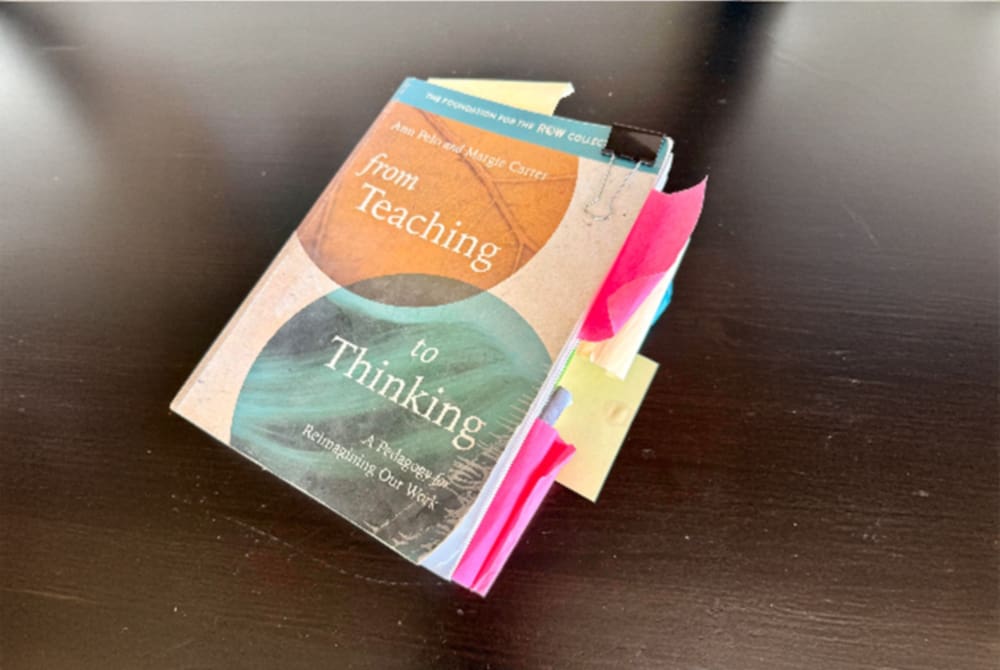
We four shared the goal of creating change in that professional learning landscape. We wanted to learn in community, to truly support the whole educator—body, mind and heart—and to learn new ways of thinking and being together as educators ourselves. With a boldness born out of desperate optimism that something had to shift in professional learning, we began to nurture an idea that looked something like a learning community, was strongly rooted in relationship and was long term. We wanted to center the work around “From Teaching to Thinking” and the ideas the book provokes because we saw those as timely, relevant and possibly controversial; we expected that the ideas would be stretching for some educators, just as they had been for each of us. And so our first communities of practice began. What follows are some aspects of how we lived into the change we imagined.
ADVERTISEMENT

We built the work on a strong image of educators.
A commitment to trust in the competence of and respond to the needs of the people in the communities of practice was central for us. It helped us support both educators’ individual journeys and the collective journey of each community of practice. Our goal for the CoPs was to strengthen each educator’s image of self as a pedagogical leader. To that end, we thoughtfully curated both the space and the content to gently guide the process of dialogue and reflection, but not the people. We hold a high image of educators, and believed that they came fully ready to dig into this work, bringing their voices, experiences, and longings to the relationships and conversations taking place throughout our time together. Educators heartily took up their roles as contributors and listeners.
We made room for emotions, talked overtly about values, and ensured divergent perspectives were included.
Connection, relationship and heart are at the core of our work in early childhood education. To deny this is to deny finding a purpose within our work and lives. To create a new approach to professional learning beyond a narrow focus on skills and outcomes, we needed to connect hearts and values to practice and pedagogy. To begin our work together, each CoP spent time in conversation about values that participants held about learning and community, values that enabled rich and vibrant conversations, values firmly rooted in heart. We created a shared list for each CoP to guide and inform our time together.
We believe that values and practice must be aligned. We designed the CoP meetings around questions and prompts that would invite participants to see the ways that their values were showing up—or not—in their practice. People in the CoPs began to recognize that as humans, we do not have separate sets of values for our professional and personal lives; this was a development that challenged all our thinking. We dove into a dialogue about what this meant for our work and how it felt to have this awareness of incongruence. In our conversations, we were challenged to sit with the discontent some were feeling, and as we poked at it, we saw that it rose from people’s sense that they were not living their values in daily practice. This realization was a springboard that helped us all move from the typical discussion of “what” or “how” to teach, to a focus on “why I teach the way I do” and possibly even more critically, “why do I not teach from my values?” We had all seen and felt the weight of not aligning practice with values, and this no longer felt acceptable in this transformation we were in.
In our CoPs, we honoured the rise of emotion and vulnerability, as they led us to lean into the telling, owning, and honouring of all our stories. Our groups were diverse with a wide range of experiences and multiple cultural groups. As we learned each other’s styles, we practiced leaving space for voices and expressions that were different than our own. We planned each session with opportunities for listening fully, engaging in guided reflective writing, using poetry to connect to longing, and offering generous space and time for divergent truths, perspectives and realities to emerge and be heard.
We committed to being uncomfortable and vulnerable, and to our own growth, not just to growth and change in the educators.
As we journeyed alongside educators, we held ourselves accountable to our own growth. We did not want to facilitate these groups from a safe distance. We chose to lean in and hold questions, thinking, emotions and tensions together, in the hope of providing breadth and depth to our thinking, living and being in this world. As some educators dug into conversations provoked by the ideas from the book with conviction and ease, others grappled with change, tension and unrest. As facilitators, we were determined to hang in there with this disequilibrium, not trying to resolve it but to celebrate it as a step towards the ongoing growth and evolution of educators. (Pelo & Carter, 2019).
These tough and tender conversations demanded that we become more fully human by engaging in relationships, by digging into vulnerability, by leaning into our core values, and by holding space for one another—even through some long silences. Yes, we did have another choice: to move to safer conversations, to take the role of the expert, and to preplan and read the book in a certain order. But we chose to stay in the present, to stay open and engaged and to let the CoP develop organically.
We emphasized relationships, not efficient transmission of content. We took time to revisit and to look again, instead of just barreling ahead.
We decided to step into “brave spaces” with no rigid outcomes, because we wanted a democratic space in which everyone would have the opportunity to “show up, be seen” (Brown, B., 2019) and have their voices heard. We created opportunities to nurture strong relationships among the participants in the CoP. We respected, honoured and loved the offerings made by each participant as we took time to let our relationships grow “simply because the space [was] there” (Brown, J., 2008).
We specifically built in revisiting time at the start of every session, revisiting relationships and connections as well as the material we had covered previously. We saw the power of time to rethink and think again with one another after having had time between meetings to practice in our own classrooms and centres. This revisiting time reignited our collective work and connections with one another and gave a steadying platform from which we could launch into the new learning ahead of us.
So What? Now What?
As the year of study and dialogue came to a close, we invited participants to linger in the CoP for another year or launch from the CoP to create a new group for dialogue and study. For those that launched, many wanted to take “From Teaching to Thinking” back to their ECE programs and communities. They were eager to invite others to share, to question and to provoke with the same spirit of curiosity and vulnerability they had experienced. Others chose to create CoPs to study the revised “BC Early Learning Framework.” The launchers took what we had woven together and used it as their road map to reimagine professional learning in their context. The four of us stayed in contact with our launchers, supporting them as mentors and essential friends.
For those who lingered with us, we asked them to bring a thinking partner into a new year of work together, anchored by the ROW book “You Can’t Celebrate That! Navigating the Deep Waters of Social Justice Teaching.” Our hope was to build on our work with “From Teaching to Thinking”—to build on our capacity for vulnerability and reflective thinking, so we could have the tough and tender social justice conversations this book would unearth. We four wanted to continue conversations that challenged us, and we recognized social justice was a conversation we had not engaged in publicly in our professional lives. With our country’s commitment to the calls to action of the Truth and Reconciliation Commission with Indigenous people, and the critical reflection about identities, social responsibility, and diversity that the revised BC ELF calls us to engage with, we knew we needed to be brave and enter the conversation. Margie Carter’s words in “From Teaching to Thinking” resonated: “We can no longer avoid talking about the dynamics of racism, power and privilege, as they inform the perspectives we bring to our teaching practices, and are always at play in our wider communities” (Pelo and Carter, 2019).
We are in a continual state of reimagining our work. We have lived into our longing, have humanized our approach by focusing on the heart and mind of the educator. Nurturing collaboration has fostered a disposition for authentic and contextual dialogue. We recognize we must endeavour to continuously reimagine our professional learning.
We are not done.
References
Brown, B. (2019). The Call to Courage. Directed by Sandra Restrepo.
Brown, J. (2008). A Leader’s Guide to Reflective Practice. Trafford Publishing, Indianapolis.
Jaboneta, N. (2019). You Can’t Celebrate That! Navigating the Deep Waters of Social Justice Teaching. Lincoln, NE; Exchange Press.
Pelo, A. and Carter, M. (2019). From Teaching to Thinking: A Pedagogy for Reimagining Our Work. Lincoln, NE; Exchange Press.

Nicky Byres is the Executive Director and Pedagogical Guide at the Society of Richmond Children's Centres in British Columbia BC Canada. She leads a multi-site non profit child care organisation with 13 programs in 6 locations. She is also an Instructor in the ECE Training Program and a Community of Practice Mentor and Facilitator. She is often called on to work with child care leaders and to offer professional learning that is contextual and accessible. Nicky is also an Exchange Leader and supports the Education for Democracy work of ELI and Exchange.

Jacqueline Ewonus is the program director at SFU Childcare, working with over 70 educators in 17 programs for children from birth to 12 years. She has worked in the child care field in different capacities for over 30 years; on the floor, as a licensing officer, and as an instructor in early childhood in Burnaby, British Columbia.

Lisa Nicholson is the program coordinator and instructor for the ECE program with Delta School District, Continuing Education, who recently joined the ROW Initiative leadership transition team. She is a proud early childhood educator of more than 30 years, who continues her journey of teaching with heart.

Working from an ethic of care, Jen Vanderberg has worked in a variety of roles supporting children, families and educators for 30 years in British Columbia, Canada. She serves as an instructor of ECE and coordinator of student practicum, a child care advocate and a community of practice facilitator and consultant.
Share this Story
Print Friendly Version

ADVERTISEMENT

Related


ADVERTISEMENT